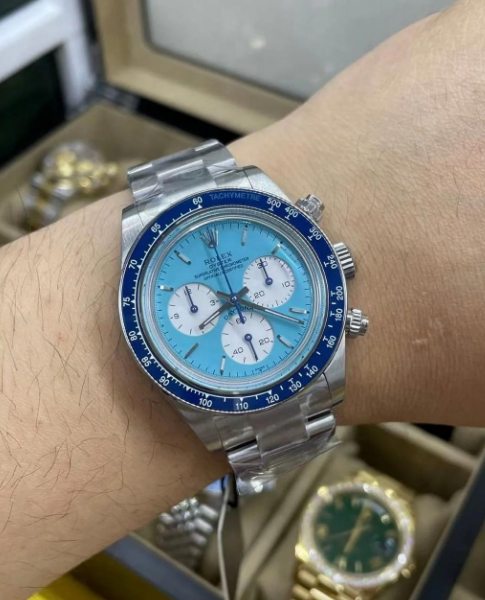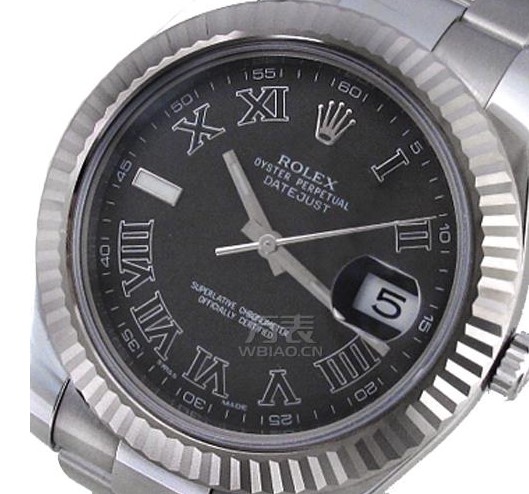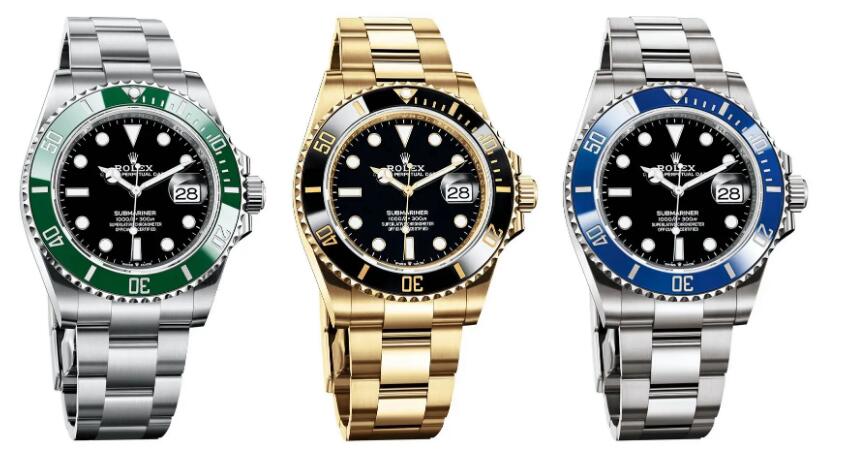
For the average person, the price tags on luxury replica watches are prohibitively high—aspirational yet unattainable. Consequently, many might be tempted by the opportunity to acquire a counterfeit timepiece that is virtually indistinguishable from the genuine article, at a cost representing merely a fraction—perhaps one-tenth or even one-hundredth—of the original price. Given that many Swiss brands source components from Asia, counterfeiters in the region often enjoy easier access to the very same original machinery used to manufacture parts such as watch cases and bracelets. As a result, distinguishing between authentic and fake timepieces has become increasingly difficult; in some instances, even opening the watch case is insufficient, as some counterfeiters employ genuine rotors to conceal fake movements.
Rolex stands as the world’s most renowned luxury watch manufacturer—and, consequently, a prime target for counterfeiters. Globally, over 25% of all fake watches are Rolex imitations, and the luxury watch counterfeiting industry as a whole is valued at billions of dollars. Fortunately, the era in which counterfeiters could deceive consumers merely by relying on precision-machined cases, meticulously crafted dials, and smooth-sweeping second hands is drawing to a close. Although counterfeiters can leverage modern manufacturing technologies to produce highly realistic fakes capable of fooling inexperienced enthusiasts, a little research—specifically, knowing what signs to look for—is all that is needed to avoid falling victim to such scams.
Nowadays, major watch manufacturers have developed sophisticated, complex, and virtually unreplicable anti-counterfeiting features. fake Rolex, for instance, incorporates multiple layers of security into its timepieces; while some of these measures are proprietary to the brand, others are also utilized by other manufacturers. Some anti-counterfeiting features are immediately obvious—even seamlessly integrated into the watch’s overall design—while others require the aid of a magnifying glass or specialized UV light to be detected. Still others require interaction with a smartphone, thereby enhancing security to an even higher level. All of these measures are designed to combat counterfeiting and ensure that consumers are purchasing authentic timepieces.
Rolex, for example, laser-etches a tiny, hidden crown emblem onto the sapphire crystal at the 6 o’clock position; this emblem typically becomes clearly visible only when viewed under magnification or specialized lighting. This laser-etched crystal serves as a high-level anti-counterfeiting feature. While not exclusive to fake Rolex—though widely associated with the brand—it is a technique rarely employed by other manufacturers. Even if counterfeiters were able to etch a brand logo onto the crystal, they would struggle to replicate the level of precision achieved by Rolex.